CAD Design
My pipes are primarily handmade in the traditional format and style and aided by the adoption of modern engineering design techniques. All my pipes and components are all hand finished and voiced in the traditional manner. The more complex UPs require internal bore reaming using a series of tapered variable-conical reamers but the NSPs have a simpler linear bore. Both UP and NSP primary bores are developed using bagpipe variations of gun-drills with bagpipe air-driver and custom cutting heads.
At Coquetdale Pipes I am engineering based by profession having worked extensively in Computational Fluid Dynamics (CFD). I have developed custom Computer Aided Design (CAD) and Computer Aided Manufacture (CAM) skills and applied these in the design and manufacture of my pipes. These methods include rapid prototyping of new designs, creation of 3D models and CAD rendering of instruments and the conversion of these into Computer Numerical Control (CNC) techniques used in the manufacturing process for control of my workshop machinery.
I use CNC techniques in taking prepared bored chanter and drone blanks to their part finished profiles and shape. They also are used in precision cutting of tone holes, key slots & seats and in making the decorative mounts for the pipes in hardwoods or imitation ivory, as well as in 3D key cutting and other components in machinable brass.
This engineered approach enables local manufacture in my workshop of all parts through to the final product, in a highly controlled manner resulting in excellent repeatability and quality control.
I extensively use CAD to prepare CNC control code for cutting components and to visualize and render design innovations and developments in 3D and thus optimize modifications. This enables me to continually improve my designs and ensure production quality control and repeatability.
CNC Methods
The CNC methods I have developed and apply in construction of my pipes use CAD/CAM as the source 3D shapes and 2D profiles for keys, bellows, chanters, and drones. These are cut from my standardized blank designs in wood or brass to provide engineered repeatability in form and detail in each of the components. This engineered approach ensures that when a component works after re-design or optimization, the next and those to follow will work just as effectively and thereby reduces variability.
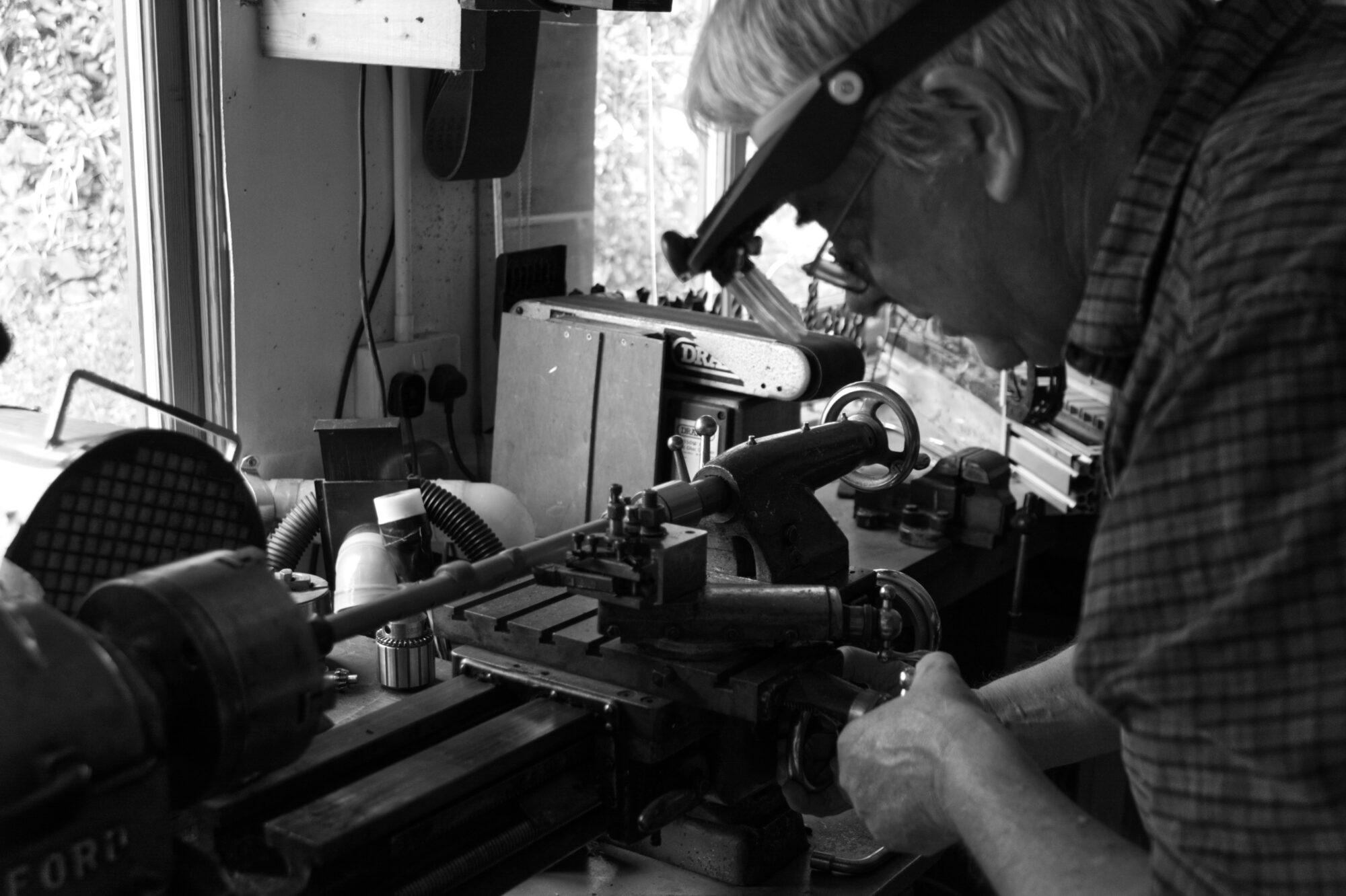
Much work is done by hand in my pipe making process and in hand-reaming and final voicing of chanters, but the CNC methods assist repeatability of production in the basic profiling, key block cutting and initial key work. My tone wood blanks for the CNC process are carefully produced and bored on a manual Myford Super 7 lathe and the same lathe is used for finishing in the traditional manner.
My keys designs are cut from machinable brass using 3-axis CNC milling machines which enable ‘2.5-dimensional cutting’, shaping the top and side surfaces of the key and providing most of the 3D shape, the rest of which is developed by hand and the traditional nickel silver key spring added.
A similar method is applied to bellows cheeks which are cut on the CNC milling machine. Decorative inlay can be added in this manner as can shaping and pocketing the holes for bellows air intake and outlet and removal of wood inside the bellows (to reduce weight in heavier woods). Brass components for the bellows are also cut using the CNC milling processes and I have developed options for profile 2D and fully 3D cutting.
The other important operation performed using CNC techniques is the installation of tone holes, key-slots and key-pad seats using the smaller of two CNC milling machines. This enables a chanter to be mounted axially on a fixed lathe-style attachment and rotated as holes and slots need to be applied to the chanters and regulators (a simple hand-controlled pseudo 4th axis). All these CNC techniques help produce repeatable results which increase both the reliability of the instrument voicing and the speed of production. This keeps costs for the sets competitive and maintains high product quality control throughout the manufacturing process.